
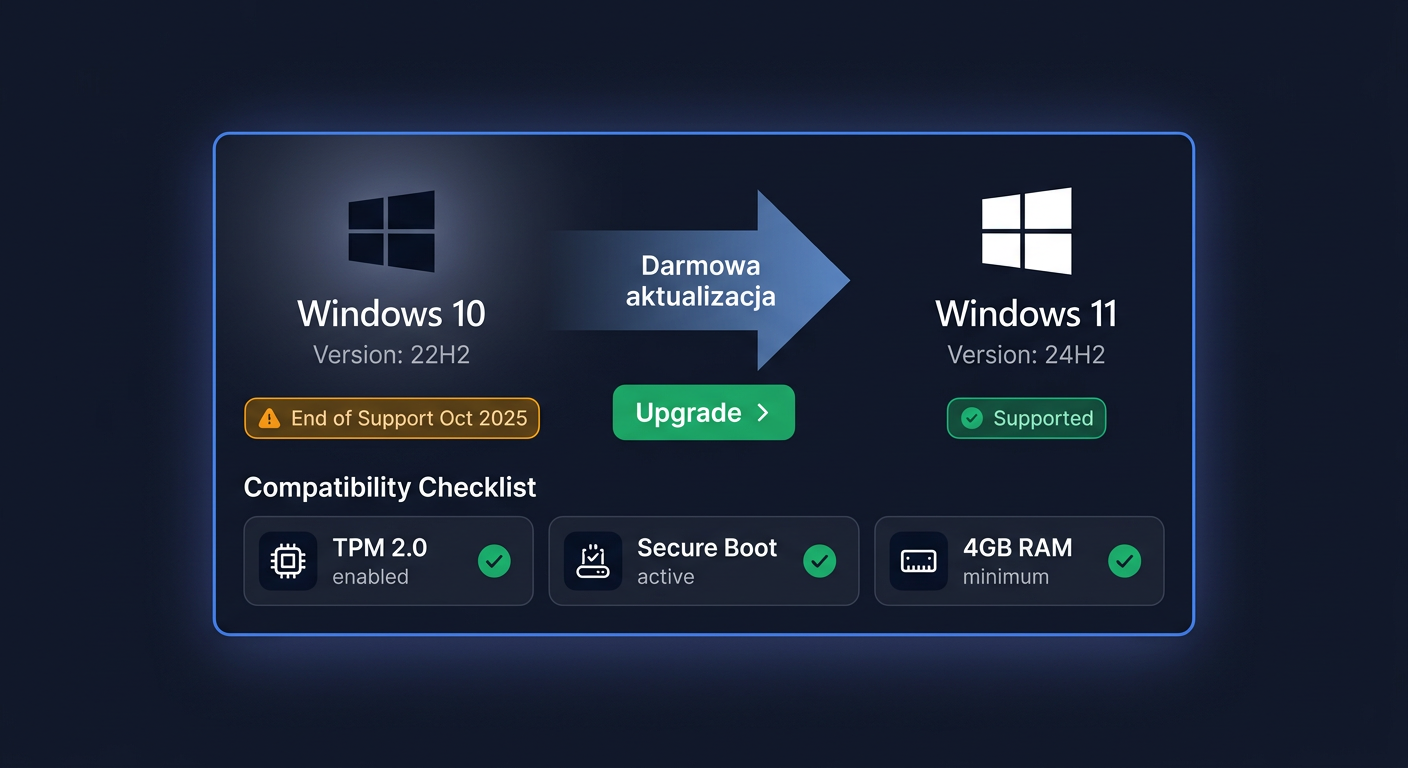
Windows 10 ESU Year 3 (2027–2028) — Extended Security Updates for the last year of support
Windows 10 ESU Year 3 includes the last, third year of the Extended Security Updates program, i.e., the period 2027–2028. This solution is for companies and users who, for technical, operational, or budget reasons, cannot yet switch to a newer system but want to continue receiving critical security fixes for Windows 10.
Migration note: ESU does not replace environment modernization. This is a bridging solution that extends system security, but does not provide full platform development. If you plan to maintain Windows 10 after the standard end of support, it's worth preparing a migration schedule to Windows 11 or a newer environment in parallel.
What does Windows 10 ESU Year 3 include
By purchasing Windows 10 ESU Year 3, the customer receives the right to activate the third year of extended security updates for a compatible Windows 10 installation. In practice, this means:
- access to critical and important security updates published as part of the ESU program,
- the possibility of maintaining a protected system in the last year of the program,
- legal activation of extended support for the licensed device,
- compatibility with the Microsoft activation mechanism, including activation using
slmgr.vbs.
It's worth remembering that Year 3 assumes continuity of the program. This means that this stage includes cumulative logic: updates are cumulative with respect to Year 1 and Year 2. In other words, the environment should be prepared in accordance with the requirements of the previous years of the ESU program.
Requirements and compatibility
Before purchasing and installing, make sure that the environment meets the technical requirements:
- a compatible edition of Windows 10 that supports the ESU program,
- a properly activated base system,
- required preparatory updates and support for the latest service packs required by Microsoft installed,
- continuity of the ESU program, i.e., the environment's readiness to deploy Year 3 after the previous stages,
- administrator privileges to install the key and activate.
If you manage multiple workstations, remember the licensing principle: one license applies to one device, unless the offer description states otherwise.
Installation and activation
Activation can be performed graphically or from the command line. In practice, corporate environments most often use CMD commands run as an administrator.
Activation via GUI
- Open the system activation properties.
- Select the option to change the product key.
- Enter the key assigned to Windows 10 ESU Year 3.
- Confirm and wait for the online activation attempt.
- If online activation fails, use phone activation.
Activation via CMD
Run Command Prompt as administrator, and then use:
slmgr.vbs /ipk XXXXX-XXXXX-XXXXX-XXXXX-XXXXX
slmgr.vbs /ato
Where:
slmgr.vbs /ipkinstalls the product key,slmgr.vbs /atostarts online activation.
If phone activation is required, you can use the Microsoft hotline:
00 800 121 1654
In the case of phone activation, prepare the installation ID and device data. The consultant or automated system will provide the confirmation ID needed to complete the process.
For any further assistance or questions, please contact us at kontakt@kluczesoft.pl or visit the KluczeSoft website for more information.
Activation Verification
After activation, it's worth checking if the key has been accepted correctly and if the system is ready to receive ESU updates.
Useful commands:
slmgr.vbs /dlv
slmgr.vbs /dli
slmgr.vbs /xpr
Most commonly used meanings:
slmgr.vbs /dlvdisplays detailed license information,slmgr.vbs /dlidisplays a brief license status,slmgr.vbs /xprhelps to check the activation status.
Additionally, it's worth:
- running Windows Update,
- checking if the system is downloading current security patches,
- confirming version compatibility and the presence of required preliminary updates.
Troubleshooting
Below are the most common problems encountered during ESU Year 3 activation.
1. Invalid Key Error
Symptom: the system rejects the key during slmgr.vbs /ipk.
Possible causes:
- typo in the key,
- using a key not intended for this year's program,
- system edition incompatibility.
What to do:
- re-paste the key without manual rewriting,
- check if it's indeed ESU Year 3,
- confirm the Windows 10 version and edition.
2. Online Activation Error during slmgr.vbs /ato
Symptom: the key installs correctly, but activation fails.
Possible causes:
- internet connection issue,
- temporary unavailability of activation services,
- failure to meet preparation requirements.
What to do:
- check internet connectivity and firewall,
- retry after a few minutes,
- use phone activation at 00 800 121 1654.
3. System Not Receiving ESU Updates Despite Activation
Symptom: activation appears correct, but Windows Update does not offer expected patches.
Possible causes:
- missing prior required components for the program,
- incomplete updates from Year 1 or Year 2,
- damaged Windows Update components.
What to do:
- check system status and full update history,
- install required preparatory updates,
- restart Windows Update service and perform a restart.
4. Activation After Hardware Change or on Wrong Device
Symptom: the key does not activate on the target computer.
Possible causes:
- activation was performed on a different device,
- hardware licensing assignment rules were violated.
What to do:
- verify which computer the key was used on,
- ensure the license is applied according to its intended use,
- if necessary, contact support and prepare activation data.
For assistance, please contact us at kontakt@kluczesoft.pl or call 00 800 121 1654.
Comparison with Alternatives
ESU Year 3 is a good choice when you need the last year of protection and time for an organised migration. However, it's not the only option.
- Migration to Windows 11: the best long-term solution, if the hardware meets the requirements and applications are compatible.
- Device replacement: suitable where older hardware no longer allows for safe and cost-effective operation.
- Virtualisation or isolation of older systems: useful in environments with legacy applications, but requires a good security policy.
- ESU Year 1 or Year 2: relate to earlier stages of the programme; Year 3 is intended for environments maintaining continuous support until the last year.
If you're purchasing packages or bundles, remember:
- each product has a separate key,
- keys can be installed on different computers, in accordance with the licensing rules of the given product,
- buying a bundle usually means savings compared to individual purchases.
For clarity:
- in Windows, activation is done through
slmgr.vbs /ipkandslmgr.vbs /ato, - in Office,
ospp.vbs /inpkeyandospp.vbs /actare used, - antivirus programs are usually activated through the manufacturer's website,
- CAL is a legal document/licence, not installed software.
Summary
Windows 10 ESU Year 3 (2027–2028) is the last year of extended security updates for Windows 10. This solution is for those who still need to maintain an older environment, but want to do so in a compliant and secure manner. However, it should be treated as a transitional phase, not a target strategy for system maintenance.
If you need help with activation, especially when online activation fails, you can use Microsoft's phone activation at:
00 800 121 1654
or contact KluczeSoft at kontakt@kluczesoft.pl for assistance.
Where to buy the original key
Need a legal key? Check the offers at kluczesoft.pl:
All keys are brand new, delivered electronically with a VAT invoice.